Table Of Content

Before this, only artistic collages provided the possibility to blend photography, illustration, and CGI elements. As human development progressed, typography became more important since aesthetic interest was being broadened and the mind was increasingly obtaining more information. In the 11th century (960 – 1279), longer scrolls and books were produced, making them widely available to the masses. Fast forward just a couple of thousand years later, you’ll discover the Blau Monument (3100 – 2700 BC), a pair of inscribed stone objects from Mesopotamia, which is now located in the British Museum. It’s the first known artistic composition artifact to use both words and pictures on it.
The History of Graphic Design: From Cave Paintings to AI Art
While it’s unclear what humans were communicating, it’s obvious they were communicating visually. Explore the transformative world of garment printing in our comprehensive guide. The prototype for Renaissance book design was the Aldine Press’s 1499 Hypnerotomachia Poliphili, believed to be written by Francesco Colonna. The design of the work achieves an understated simplicity and tonal harmony, and its elegant synthesis of type and image has seldom been equaled. The layout combined exquisitely light woodcuts by an anonymous illustrator with roman types by Griffo utilizing new, smaller capitals; Griffo cut these types after careful study of Roman inscriptions.
Access Paper:
You’ve probably heard of the Lascaux caves in Southern France, Rome’s Trajan’s Column, or the illuminated manuscripts of the Middle Ages. The German school of poster design called Plakatstil (“Poster Style”) similarly continued the exploration of pure form. Initiated by Lucian Bernhard with his first poster in 1905, Plakatstil was characterized by a simple visual language of sign and shape. Designers reduced images of products to elemental, symbolic shapes that were placed over a flat background colour, and they lettered the product name in bold shapes. Plakatstil gained numerous adherents, including Hans Rudi Erdt, Julius Gipkens, and Julius Klinger. In the digital world, tech giants like Apple and Google have championed minimalism in operating system interfaces.
The death of paper
The days of treating design as existing in a vacuum, separate from its social and ecological impacts, are fading. A paradigm shift is underway in the field, motivated by personal ethics and client demand. The late 19th and early 20th centuries were a time of great artistic innovation that saw the rise of the Art Nouveau movement. Art Nouveau, meaning “new art” in French, was characterised by intricate, flowing designs often incorporating floral and plant motifs and curved lines inspired by nature. Vibrant chromo lithographed posters and packages were created to catch the eyes of potential buyers in crowded shops and markets. Brands developed logos and slogans to differentiate their products and evoke emotions in consumers.
What’s the Difference Between Graphic Design & Branding?

Good graphic design builds strong, recognizable brands, communicates messages clearly, and shapes how consumers see and react to things. Most designers use a hybrid process that combines traditional and computer-based technologies. First, hand-rendered layouts are used to get approval to execute an idea, then the polished visual product is produced on a computer. It can be argued that graphic communications with specific purposes have their origins in Paleolithic cave paintings and the birth of written language in the third millennium BCE. Using a bright color scheme, borrowed from 60s pop art and psychedelic art, and combining it with German modernism Aicher creates this visual graphic program.
Second, think about all of the social media content and advertisements you see every day. There are also a number of principles that graphic designers need to follow in order for their designs to be effective and grab attention. Virtual Reality (VR), Augmented Reality (AR), and AI are transforming how Designers create and audiences experience visual content. Ethical Design and sustainability are gaining importance, encouraging Designers to advocate for positive change. Personalisation leverages data for tailored visuals, while kinetic typography adds motion to text. As we venture into the future, the ever-changing nature of Graphic Design promises to keep pushing boundaries and shaping how we connect, communicate, and create.
Graphic Design Online Short Course UCT - University of Cape Town
Graphic Design Online Short Course UCT.
Posted: Fri, 19 Jan 2024 10:27:57 GMT [source]
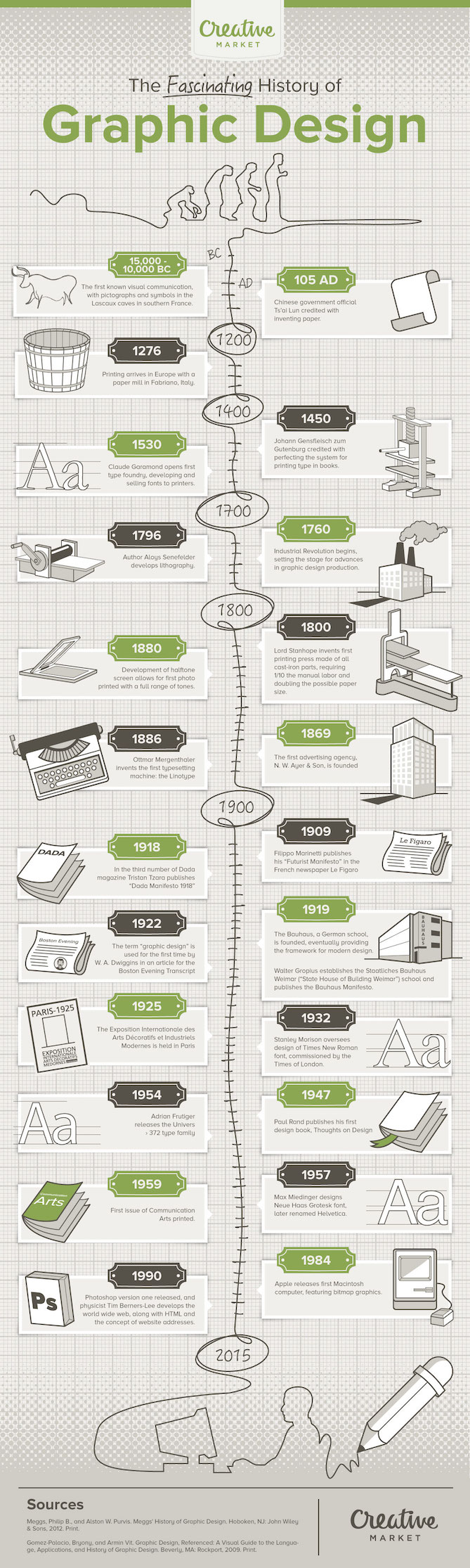
Therefore, typography was among the few acceptable ways of artistic expression at the time. The invention of paper in 105 AD by a Chinese man led to the concept of printing. Around a thousand years later, in 1045 AD, the first moveable type was invented. In 1276, a paper mill arrived in Fabriano, Italy, and this era was known for officially creating the first paper mill in Europe. But to truly get the anchor point of graphic design – and how it’s been cropped through the ages – an excellent place to start is by understanding its pixelated history. While early minimalism responded to the clutter and complexity of 20th-century design, today's minimalism reflects changing social values.
Art Nouveau and the Birth of Graphic Design as an Art Form
Photo manipulation created a whole new subcategory of graphic design, blending together elements of photography, illustration, and CGI (it would have made the Gesamtkunstwerk artists proud). With one foot in modernism and the other in post-modernism, legendary designer Paul Rand helped lead graphic design into its current form. He posted his theories and ideologies in the seminal work Thoughts on Design, which largely shaped the future of the entire graphic design industry. Brands were now able to use a lot of the familiar marketing tools we know today, such as characteristic color schemes and building emotional connections through slice-of-life scenes.
The History of Packaging; The Evolution Of Packaging Design - Online graphic design magazine - RoozRang
The History of Packaging; The Evolution Of Packaging Design - Online graphic design magazine.
Posted: Mon, 14 Aug 2023 07:00:00 GMT [source]
Pictograms, another early form of Graphic Communication, consisted of simple drawings representing objects and concepts. These symbols conveyed information, often inscribed on surfaces like rocks or clay tablets. Pictograms laid the foundation for written language by creating a visual association between the symbol and its meaning.
Postmodern Designers embraced Eclecticism, mixing various styles, eras, and cultural references. The rejection of a Singular Design Doctrine allowed for more playful and experimental approaches to Graphic Design. Vintage logo designs, which ruled the media in the 1960s, are likely to make a comeback. The idea is to go back and acquire a blend of hip, medieval designs like regal seals, family coats of arms, and ornament scrolls. In 1922, William Addison Dwiggins explained what graphic design was in his book.
Brand identity designers have to be well-versed in graphic design trends, what types of designs resonate with customers and more. While women won their right to vote in Britain in 1918 and in the United States in 1920, some groups were still discriminated against, especially in the art and design field, despite their massive contributions. Cipe Pineles, born in 1908 in Vienna, Austria, was one of the first women to work as a director at a major magazine. She worked at Seventeen, Charm, and Glamour during her career in New York, as well as working as an illustrator and the Director of Publication Design at Parsons School of Design in the 70s.
These manuscripts showcased the sheer skill and artistry of the monastic scribes while spreading religious teachings and recording histories. Famous examples include the Book of Kells, the Lindisfarne Gospels, and the Très Riches Heures du Duc de Berry. Through their visual magnificence, illuminated manuscripts had an outsized influence as sacred texts and art masterworks.
This technique is believed to have been invented by Daniel Hopfer (c. 1470–1536) of Augsburg, Germany, who decorated armour in this way, and applied the method to printmaking. Etching soon came to challenge engraving as the most popular printmaking medium. Its great advantage was that, unlike engraving which requires special skill in metalworking, etching is relatively easy to learn for an artist trained in drawing. China holds most of the records for printing discoveries, including non-papyrus paper making, woodblock printing, and movable type—all of which occurred earlier than you might have guessed. Nearly a millennium later (in 1045 AD), moveable type was invented, which allowed characters to be placed individually for printing.


No comments:
Post a Comment